This article explains how regenerative medicine can address knee pain through a layered treatment approach. It discusses common knee conditions like cartilage wear and tendinitis, helping readers understand when to consider regenerative options alongside movement and recovery strategies.
When knee pain persists despite physical therapy, activity modification, and over-the-counter medications, many patients face a difficult choice between continuing to manage symptoms or pursuing surgical intervention. Regenerative medicine offers a middle path that targets the biological source of knee damage rather than masking symptoms or replacing joint structures. For the right patient, it can be the smartest next step before considering more invasive options.
What Makes Regenerative Medicine Different for Knee Pain?
Conventional knee pain management follows a predictable sequence: rest, anti-inflammatories, physical therapy, cortisone injections, and eventually surgery when conservative measures fail. Each step manages symptoms without addressing the underlying tissue damage that generates the pain.
Regenerative medicine breaks this pattern by introducing biological agents that support actual tissue repair. Rather than suppressing inflammation or replacing damaged structures, regenerative treatments deliver concentrated growth factors, signaling molecules, and repair cells directly to the site of injury.
The fundamental difference is trajectory. Conventional management slows the decline. Regenerative treatment aims to reverse it — or at least halt progression while the body repairs what it can.
This approach is particularly relevant for the knee because knee cartilage has extremely limited natural healing capacity. The avascular nature of cartilage means it receives minimal blood supply, which restricts the delivery of repair cells and nutrients. Regenerative treatments bypass this limitation by delivering those biological resources directly.
Which Knee Conditions Respond to Regenerative Treatments?
Regenative approaches work best for conditions with identifiable soft tissue or cartilage damage where sufficient structural integrity remains:
Knee osteoarthritis (mild to moderate): PRP injections into the joint reduce inflammation, slow cartilage breakdown, and stimulate proteoglycan production. Multiple clinical trials show PRP outperforming hyaluronic acid and cortisone for osteoarthritis symptom relief at 6 and 12 months.
Meniscus tears: Partial meniscus tears, particularly in the vascular zone (outer third), can respond to regenerative treatment. The growth factors in PRP support healing in tissue that would otherwise heal slowly or incompletely.
Patellar tendinopathy: Chronic patellar tendon pain that fails eccentric exercise programs responds well to PRP. The treatment addresses the failed healing response that characterizes chronic tendinopathy.
Ligament sprains: Partial MCL and LCL sprains may benefit from prolotherapy or PRP to accelerate healing and restore ligament tensile strength.
Post-surgical support: Regenerative treatments are increasingly used as adjuncts following ACL reconstruction, meniscus repair, and cartilage restoration procedures to enhance biological healing.
How Do PRP and Stem Cell Therapy Compare for Knees?
Patients frequently ask which regenerative approach is better for their knee condition. The answer depends on the type and severity of damage:
PRP (platelet-rich plasma) is the most studied regenerative treatment for knee conditions. It uses your own blood, concentrated to deliver high levels of growth factors. PRP is well-suited for:
- Mild to moderate osteoarthritis
- Chronic tendinopathy
- Partial ligament sprains
- Early cartilage degeneration
Stem cell therapy delivers mesenchymal stem cells capable of differentiating into cartilage, tendon, and other connective tissues. It is typically reserved for:
- More advanced cartilage damage
- Larger or more complex injuries
- Cases where PRP alone has provided insufficient improvement
- Patients seeking maximum regenerative potential
In practice, these treatments are often complementary. Some protocols combine PRP with stem cell therapy, using the growth factors in PRP to create an optimal environment for stem cell activity. Your clinician will recommend the most appropriate approach based on imaging, clinical examination, and your treatment history.
What Should You Know Before Starting Treatment?
Informed decision-making requires understanding both the potential and the limitations of regenerative knee treatment:
Realistic expectations matter. Regenerative medicine is not a guaranteed cure. Success rates vary by condition, severity, and patient factors. Patients with mild to moderate osteoarthritis report improvement rates of 60% to 80% in clinical studies. Those with severe bone-on-bone arthritis see lower response rates.
Imaging guides treatment decisions. An MRI or diagnostic ultrasound before treatment helps identify the specific structures involved and determines whether sufficient tissue integrity exists for regenerative repair. Treating blindly without imaging reduces the likelihood of a good outcome.
Rehabilitation is not optional. Regenerative injections create the biological conditions for repair, but the joint needs appropriate loading and movement to guide tissue remodeling. Patients who complete a structured rehabilitation program alongside regenerative treatment consistently outperform those who rely on injections alone.
Results take time. Unlike cortisone, which provides rapid relief, regenerative treatments follow a slow improvement curve. Most patients begin noticing meaningful changes at 4 to 8 weeks, with peak improvement at 3 to 6 months.
What Does the Treatment Process Look Like?
A typical regenerative knee treatment at a well-equipped clinic follows a structured process:
Initial evaluation: Comprehensive history, physical examination, and imaging review. This determines whether your knee condition is appropriate for regenerative treatment and which modality is best suited.
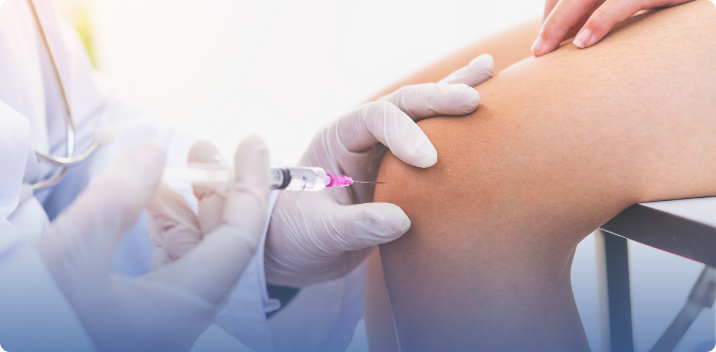
Treatment day: For PRP, a blood draw is processed to concentrate platelets. For stem cell therapy, bone marrow aspiration may be performed. The regenerative preparation is then injected into the knee under ultrasound guidance.
Follow-up protocol: Activity modification for 1 to 2 weeks, progressive rehabilitation starting at weeks 2 to 3, and clinical reassessment at 6 to 8 weeks. A second treatment may be recommended based on the response.
Long-term monitoring: Functional benchmarks and periodic reassessment track the durability of improvement and determine whether maintenance treatments are beneficial.
Consider Regenerative Knee Treatment at Prince Health in The Woodlands
Knee pain that has not responded to conventional conservative care does not automatically mean surgery is the only remaining option. At Prince Health, located at 10847 Kuykendahl Rd #350, The Woodlands, TX, we evaluate knee conditions with diagnostic imaging, identify the specific tissue damage, and determine whether regenerative treatment can provide meaningful improvement for your situation. Every patient receives an honest assessment of what regenerative medicine can and cannot do for their specific knee problem.
Frequently Asked Questions
Is regenerative medicine better than knee replacement?
Regenative medicine and knee replacement serve different stages of joint degeneration. For mild to moderate osteoarthritis with remaining cartilage, regenerative treatment can delay or eliminate the need for replacement. For severe bone-on-bone arthritis with significant structural collapse, knee replacement may still be the most appropriate intervention. The goal is matching the treatment to the stage of disease.
How long do the results of PRP knee injections last?
Clinical studies show PRP benefits lasting 9 to 18 months for knee osteoarthritis, with some patients maintaining improvement beyond two years. The duration depends on the severity of cartilage damage, activity level, body weight, and whether the patient completes rehabilitation. Maintenance injections at 12 to 18 month intervals may extend the benefit.
Can you walk normally after a knee PRP injection?
Most patients walk out of the office without assistive devices after a PRP injection. Mild swelling and soreness are common for 2 to 5 days. Normal walking is typically comfortable within the first week, with progressive return to exercise over the following 4 to 6 weeks.
What is the success rate of stem cell therapy for knee arthritis?
Published studies report meaningful pain reduction and functional improvement in 60% to 80% of patients with mild to moderate knee osteoarthritis. Success rates are lower for advanced arthritis with significant cartilage loss. Proper patient selection through clinical evaluation and imaging is the most important factor in predicting a positive outcome.
Should I stop taking anti-inflammatory medications before PRP treatment?
Yes. Non-steroidal anti-inflammatory drugs (NSAIDs) like ibuprofen and naproxen should be discontinued 5 to 7 days before and 2 to 4 weeks after PRP treatment. These medications inhibit the inflammatory signaling that PRP relies on to initiate tissue repair. Acetaminophen is a safe alternative for pain management during this period.
Schedule an Appointment Today
Get optimized and highly effective care for your condition by visiting our office in The Woodlands, TX.