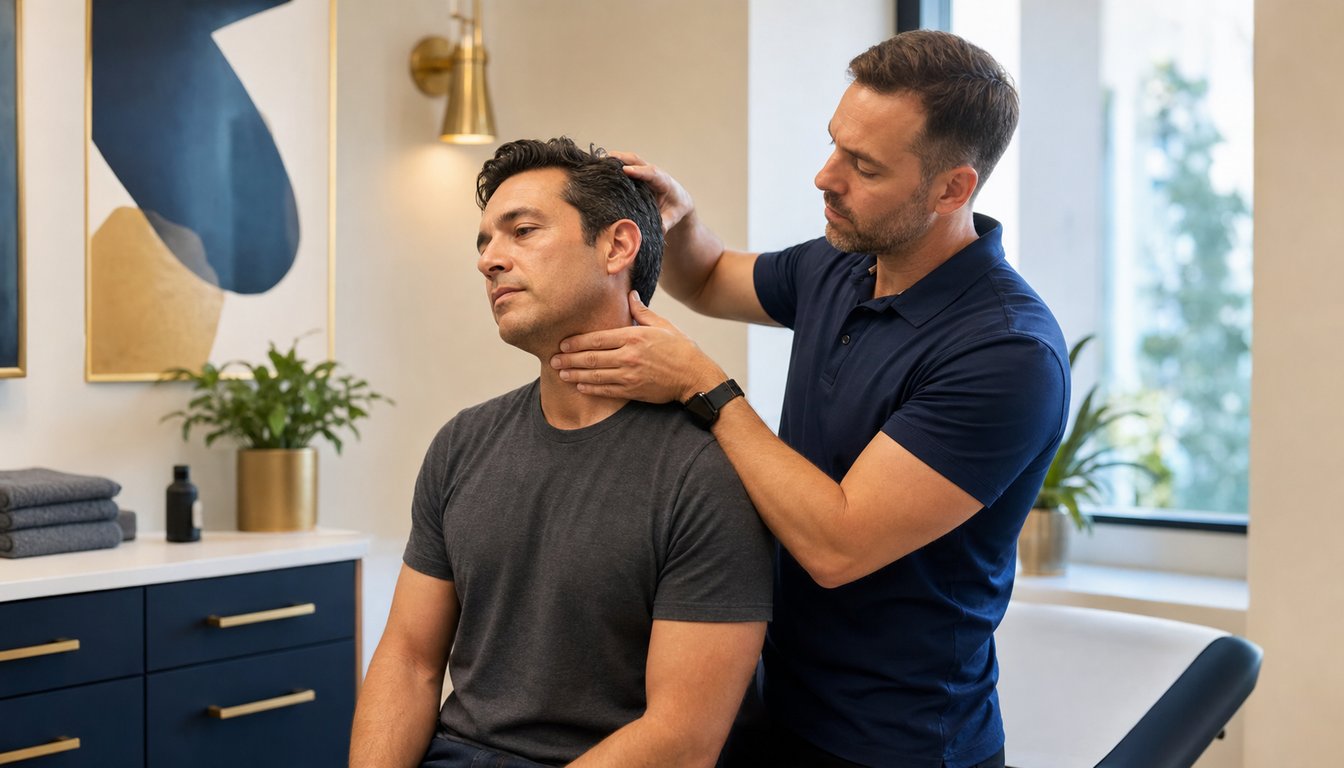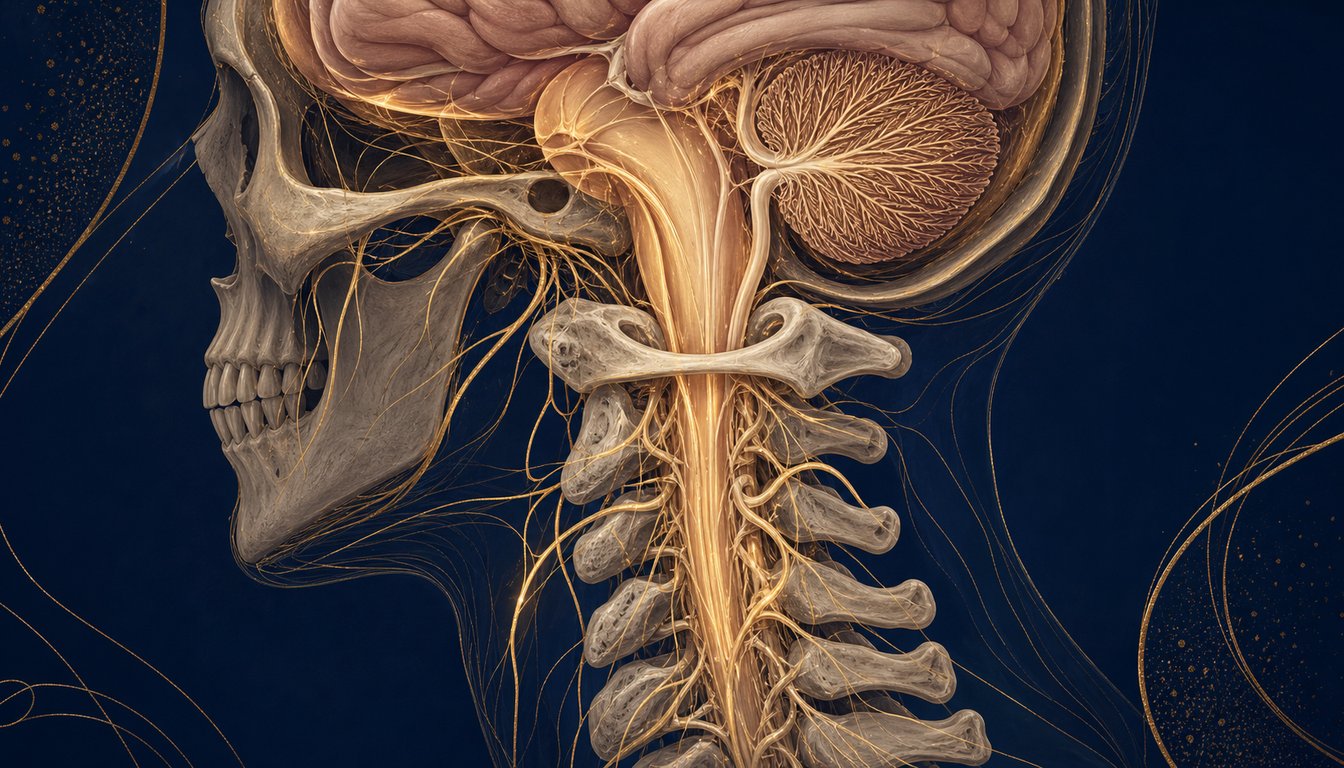
The vagus nerve drives your rest-and-repair state, and the upper cervical spine sits close to its pathway. Here is what research actually shows about chiropractic care and vagal function.
The vagus nerve has become one of the most searched topics in health, and for understandable reasons. It is the main highway of your parasympathetic nervous system, the rest-and-repair state that governs digestion, heart rate recovery, sleep quality, and how quickly you come down from stress. So when patients ask whether chiropractic care can help the vagus nerve, they are really asking whether spinal care can influence how regulated their body feels.
The honest short answer: the vagus nerve exits the skull and travels near the upper cervical spine, spinal manipulation does appear to produce measurable short-term changes in autonomic activity in some studies, and the research is genuinely mixed on how large and lasting those changes are. Chiropractic care supports nervous system function. It is not a cure for any disease of the vagus nerve.
What the Vagus Nerve Actually Does
The vagus nerve is the tenth cranial nerve, running from the brainstem down through the neck into the chest and abdomen. It carries the signals that slow your heart rate after exertion, coordinate digestion, and shift your body out of fight-or-flight. When people describe feeling wired but tired, poorly rested, or unable to settle, they are often describing a nervous system spending too much time in sympathetic dominance.
That is why vagal function matters beyond any single symptom. It sits underneath conditions Prince Health works with regularly, including POTS and dysautonomia, where autonomic regulation itself is the problem.
Why the Upper Neck Is Part of This Conversation
The anatomical connection is real: the vagus nerve exits the skull through the jugular foramen and travels alongside the upper cervical vertebrae. The upper neck is also dense with receptors that feed position and tension information into the brainstem regions that regulate autonomic balance.
The clinical reasoning follows from that anatomy. Restoring normal alignment and motion in the upper cervical spine reduces abnormal input from that region, which may support healthier autonomic regulation. That is the mechanism chiropractors describe, and it is also where honest practitioners slow down, because mechanism is not the same thing as proven outcome.
What the Research Actually Shows
Studies have measured autonomic effects of spinal manipulation using heart rate variability, a standard proxy for vagal tone. A systematic review of spinal manipulative therapy and heart rate variability found measurable short-term autonomic changes after manipulation. More recent work suggests cervical spine manipulation may influence the high-frequency component of heart rate variability, the band most associated with parasympathetic activity.
The balance matters, though: other controlled work, including a trial adding spinal manipulation to a stretching program, found no significant lasting change in heart rate variability. Taken together, the evidence supports short-term autonomic effects with real uncertainty about durability. Anyone promising vagus nerve repair from adjustments is ahead of the science.
How Prince Health Approaches It
At Prince Health, nervous system function is part of how chiropractic treatment is planned, not a separate product. The evaluation that begins every case includes neurological testing, and upper cervical findings are treated with techniques scaled to the region, including low-force instrument methods when that is what the case calls for.
What patients report during care is consistent with the short-term research: better sleep, calmer digestion, and steadier stress tolerance often show up alongside the pain improvements that brought them in. We frame those as supportive effects of restored alignment and reduced nervous system irritation, not as treatment for vagus nerve disease. Cases that look like true autonomic dysfunction get evaluated more broadly, which within our pain management and functional medicine structure can include lab work and medical review on the same chart.
The Bottom Line
Can chiropractors help the vagus nerve? The anatomy makes the connection plausible, the research shows real but short-term effects, and the honest framing is support rather than cure. If your deeper question is why your body will not downshift, that deserves a proper evaluation rather than a single-answer promise.
You can schedule an evaluation at Prince Health to have both the structural and the systemic side of that question looked at together.
Frequently Asked Questions
What symptoms suggest my vagus nerve or autonomic system needs attention?
Common patterns include a heart rate that spikes with small exertion, digestion that stalls under stress, poor sleep despite exhaustion, dizziness on standing, and a body that stays keyed up long after stress passes. Those patterns deserve evaluation, since several conditions can produce them.
Can a chiropractic adjustment stimulate the vagus nerve directly?
An adjustment does not stimulate the vagus nerve the way an implanted vagus nerve stimulator does. The plausible pathway is indirect: changing input from the upper cervical spine to brainstem regions involved in autonomic regulation. Studies show short-term autonomic shifts; durable change is not established.
Is upper cervical chiropractic safe?
For appropriate candidates, upper cervical care performed by licensed practitioners after proper screening is generally well tolerated, and low-force instrument techniques exist specifically for regions and patients that need gentler input. Screening for red flags comes first, every time.
Do you treat POTS or dysautonomia with adjustments alone?
No. Autonomic conditions like POTS get a broader workup. Chiropractic care can be one supportive layer, but at Prince Health those cases are evaluated across systems, which may include functional testing and medical review rather than adjustments alone.
Schedule an Appointment Today
Get optimized and highly effective care for your condition by visiting our office in The Woodlands, TX.